Prakash (name changed) had always been like this since he started dating.
The pattern of returning to relationships he knew were harmful. He would scroll, message, fantasize, even when he had decided, firmly, that he was done. But again he would go back to stalking the girls, following them for some time, then coming back home and masturbating to porn. The shame that followed every time, so familiar it had become part of his identity.
He did not know if he had a psychological problem or was it normal? He was bullied in school, at home by his father, in college, he was called dramatic. He wondered, more than once, if he was simply a broken person who lacked the self-discipline that everyone else seemed to have.
He was not broken. He had a recognized medical condition, formally named and classified by the World Health Organization in 2022. After he spoke openly with me about his guilt, shame, the failures of controlling these behaviours, the academic failures, the shame of lying to relatives about his career and success, he could see exactly what was wrong, what name he could give to his problematic behaviour and more importantly how to leave behind this behaviour and start the healing process.
That is what I want to give you in this article: the name, the science behind it, and the reason the name matters more than it might seem.
What the ICD-11 Actually Says
In January 2022, the WHO's International Classification of Diseases, 11th edition (ICD-11) formally added Compulsive Sexual Behavior Disorder to its list of recognized conditions under diagnostic code 6C72. It sits in the Impulse Control Disorders chapter, alongside conditions like intermittent explosive disorder and kleptomania.
It is not classified as an addiction. That placement was deliberate.
Before ICD-11, there was no equivalent code. ICD-10 had nothing. Patients who sought help could not be formally diagnosed. Clinicians had no recognized framework. Insurers had no billing code. The condition was, officially, invisible, which meant that anyone carrying this pattern was also carrying the full weight of believing it was their personal failing rather than a clinical reality.
The diagnostic criteria, as established in the foundational World Psychiatry paper (Kraus et al.), require all of the following to be present:
A persistent pattern of failure to control intense, repetitive sexual impulses or urges resulting in repetitive sexual behavior. The pattern must span six months or more. A stressful season, a breakup, a difficult month do not qualify.
Marked distress or significant impairment in personal, family, social, educational, or occupational functioning. Not embarrassment. Not regret. Concrete, ongoing damage to your actual life.
Failed attempts to control. The person has tried, genuinely and repeatedly, to stop or significantly reduce the behavior and has been unable to.
And here is the safeguard most people never hear about. The ICD-11 criteria explicitly state: "Distress that is entirely related to moral judgments and disapproval about sexual impulses, urges, or behaviors is not sufficient to meet this requirement."
If your distress comes from religious teaching, from cultural conditioning, from messages absorbed over a lifetime about what your sexuality is supposed to look like: that shame alone does not mean you have CSBD. This is not a minor footnote. For anyone from a South Asian, Indian, or culturally conservative background where ordinary sexual desire is already treated as something to manage or hide, this distinction changes everything.
Who It Affects, And Why They Stay Silent
The largest cross-cultural study on CSBD ever conducted, the International Sex Survey (Bőthe et al., 2023), surveyed 82,243 people across 42 countries. Here is what it found.
4.84% of all participants scored at high risk for CSBD. Breaking that down: 8.17% of men, 2.42% of women, and 6.46% of gender-diverse individuals met the threshold. Country-level prevalence ranged from 1.6% in Portugal to 16.7% in Turkey, showing how cultural context, stigma, and social norms shape both the disorder and the willingness to name it.
That is a substantial portion of the population. So why does this condition still feel hidden?
The same study found that only 13.7% of high-risk individuals had ever sought any treatment. Among those who had not sought help, 18.5% said they were too embarrassed. Another 6.5% said they could not afford it.
For women, the gap is wider. A 2024 review in PMC found that 68.2% of women with significant CSBD symptoms had never sought any treatment. Almost everything currently known about CSBD was drawn from studies of heterosexual men. Women's presentations are frequently unrecognized, and women's experiences remain largely unstudied.
In India, a 2025 study of 589 treatment-seeking individuals diagnosed using ICD-11 criteria found that 78.9% were seeking help for the first time. Only 14.1% had ever consulted any professional before. The researchers named what was keeping people away: "Socio-cultural norms, stigma around sexuality, limited sex education, and taboo around help-seeking create unique challenges."
These are not abstract barriers. They are the lived experience of anyone who grew up in a household where sex was never discussed, where shame was an organizing principle for how bodies and desire were understood.
What CSBD Is Not
The name "compulsive sexual behavior disorder" is new. The misunderstandings in this territory are much older, and some are still circulating.
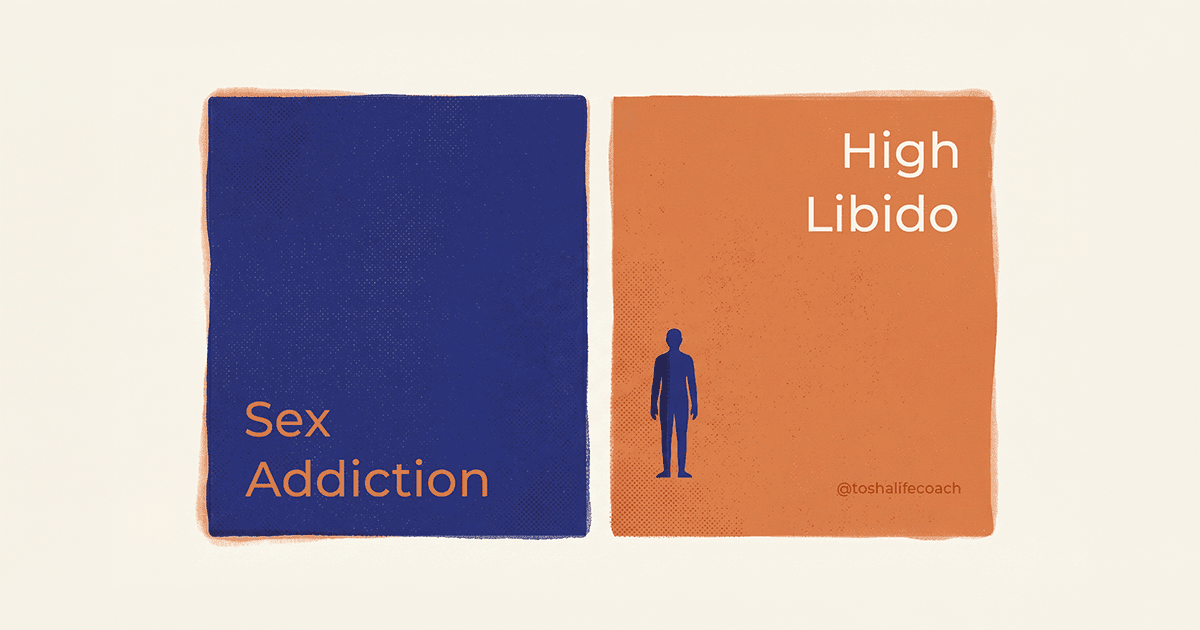
CSBD is not the same as a high libido. A high libido is a characteristic. People with high libido want sex more than average, and they can choose whether to act on that or not. CSBD involves the loss of control over that choice. High sexual frequency does not mean that you have CSBD or you are a sex addict.
CSBD is not nymphomania or satyriasis. These 19th-century terms had no clinical validity. They were moral labels dressed as medical ones, applied most often to women and gay men to pathologize non-conforming sexuality. The shift to CSBD reflects a deliberate move away from that history toward language that is value-neutral and evidence-based.
CSBD is not a DSM diagnosis. The Journal of Behavioral Addictions review (2022) notes that the American Psychiatric Association's DSM-5 does not include CSBD. In 2013, a proposed category called "Hypersexual Disorder" was rejected from the DSM. The ICD-11 inclusion is WHO's classification, used in clinical and research contexts globally. In the United States, full transition to ICD-11 billing codes has not yet occurred, meaning CSBD is not yet reimbursable through most US insurance.
CSBD is not a moral diagnosis. A 2024 Sexual Medicine Reviews analysis found that approximately 1 in 4 men seeking CSBD treatment may not actually meet clinical criteria. They are distressed because their behavior conflicts with their religious or cultural values, but the behavior itself is not compulsive and is not causing objective impairment. Treating moral discomfort as a clinical disorder causes harm. A skilled clinician distinguishes between the two.
What CSBD actually is, at a neurobiological level, involves a specific pattern in the brain. Imaging research has found reduced connectivity between the amygdala (which governs emotional reactivity and threat response) and the prefrontal cortex (the brain's impulse regulation center) in people with CSBD. The brain's "stop" signal is functionally weakened. The emotional pull toward the behavior is amplified. This is not weak character. It is a specific neurological pattern that shows up consistently in research and points clearly toward why the condition is classified where it is.
What Actually Helps
The ICD-11 classification opened the door for systematic treatment research, and that research is building.
Cognitive Behavioral Therapy (CBT) is the most evidence-supported approach. A preregistered systematic review (Leppink et al., 2023) found CBT produced large effect sizes for symptom reduction, with Cohen's d ranging from 0.82 to 4.89 across studies. One randomized controlled trial found a large effect size (d = 1.19) for sexual compulsivity reduction compared to a waitlist control. CBT works by identifying the thought patterns and emotional triggers that precede acting out, and building genuine alternative responses, not just willpower.
Dialectical Behavior Therapy (DBT) is particularly relevant for people whose compulsive sexual behavior functions primarily as emotional regulation: a way of managing states that feel otherwise unmanageable. Research from the Recovery Research Institute found DBT produced a large effect size improvement in emotion regulation (d = -1.17) and a medium effect size in emotional avoidance (d = -0.71). Its four skill modules (mindfulness, distress tolerance, emotion regulation, interpersonal effectiveness) map directly onto the triggers and maintaining factors in CSBD.
Trauma-informed approaches matter when childhood experiences underlie the pattern. Research comparing women and men with CSBD found women show higher rates of childhood sexual abuse (odds ratio 2.9) and physical abuse (odds ratio 3.7). Treating the compulsive behavior without addressing underlying trauma rarely produces lasting change.
Shame resilience work is not a standalone treatment but is often the necessary first step. The 2024 PMC review identifies shame as "the primary emotional element of CSBD" and a central barrier to both seeking help and sustaining progress once in treatment. Learning to separate your identity from your behavior, understanding that you are a person who struggles with this rather than a person defined by it, is where recovery usually begins.
Five Questions Worth Sitting With
If you are reading this because something here feels familiar, these questions, drawn from CBT and REBT self-inquiry frameworks, are a starting point for honest reflection.
-
Have you tried to stop this pattern and been unable to? Not once, but repeatedly, with genuine intention and real effort?
-
Are you continuing a behavior that no longer brings you real pleasure? Is the pull stronger than any enjoyment it actually delivers?
-
Has this pattern cost you something real? A relationship, your work, your health, your sense of who you are?
-
Are you acting against your own values, not someone else's? There is a meaningful difference between shame from cultural conditioning and the inner conflict of behavior that violates your own values.
-
Are you using this to manage something else? Anxiety, loneliness, emotional pain, boredom? Compulsive patterns often begin as a functional response to something that needed a different outlet.
These questions do not produce a diagnosis. But they point toward honest clarity, which is where useful support begins.
The Name Is Not Everything, But It Is Something
For the man who sat in my office after eleven years without a name for what he was carrying, the ICD-11 classification was not a magic fix. It did not immediately change how he felt about himself. But it gave him a name, a perspective to consider.
What had felt like a moral failure became a recognized clinical condition. What had felt like evidence of being broken became a pattern with known neurobiology, documented prevalence, and evidence-based treatment pathways. What had felt unspeakable became speakable, because it had a name.
That shift, from "I am this" to "I have this, and it can be treated," is where recovery begins for most of the people I work with.
If you have been carrying something you could not name, I want you to know: the name exists now. So does the help. Take the evidence-based help provided at Tosha Life and leave the guilt and shame behind for a more satisfied and happy life.