Sameer (name changed) had been carrying this secret for twelve years.
Not the behavior itself. That, he had lived with, managed, compartmentalized. What he had never been able to carry easily was the label he had quietly placed on himself: addict. He thought about sex more than most people. He sought it out. He spent a lot of time thinking about it. In his community, where sexuality was discussed only in terms of duty and sin, that meant something was wrong with him.
When he finally sat across from a professional, it took four sessions to establish something important: he could stop. He could see that every time in life he stood up for challenges whenever he faced them. He was not lying awake at night in withdrawal. He was not missing work, ruining relationships, or spending money he did not have. He had a high sex drive and had spent twelve years treating it like a disease.
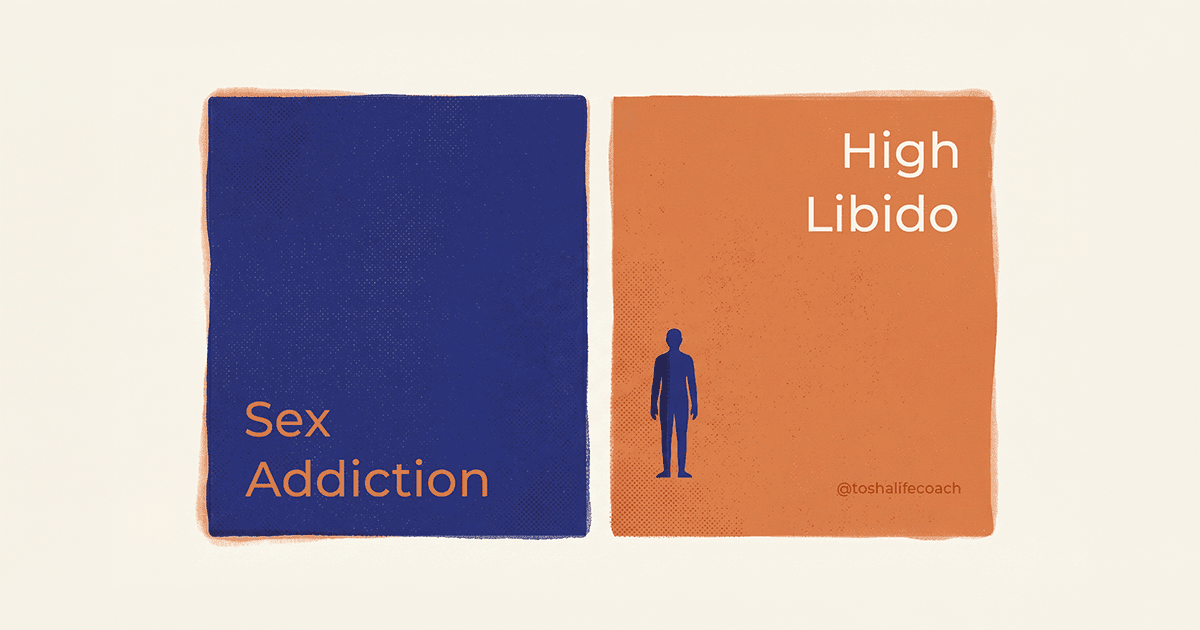
He is not unusual. In my work as a life coach and sex addiction specialist, I have seen many people arrive carrying a diagnosis they gave themselves, built not from clinical criteria but from shame. Distinguishing between compulsive sexual behavior and a high libido is not just a clinical question. It is the difference between treating a real problem and unknowingly labeling a normal behaviour as an addiction.
What Compulsive Sexual Behavior Disorder Actually Requires
The WHO's ICD-11 (2022) classifies Compulsive Sexual Behavior Disorder (CSBD) as an impulse control disorder. The clinical criteria are specific: a persistent pattern of failure to control intense, repetitive sexual impulses or urges, resulting in sexual behavior that causes marked distress or significant functional impairment, lasting six months or more.
Each part of that definition matters.
Failure to control is not the same as choosing not to control. It means trying to stop and being unable to. Marked distress or significant impairment means the behavior is causing real, measurable damage: to relationships, to work, to finances, to health, to one's own values. And the six-month threshold rules out brief periods of stress-driven behavior that resolve on their own.
The ICD-11 also contains an explicit safeguard that many people do not know about. It states directly: "Psychological distress entirely related to moral judgments and disapproval about sexual impulses, urges or behaviours is not sufficient to meet this requirement." A 2025 review in Frontiers in Psychiatry notes that this clause was deliberately included to prevent over-pathologizing people whose distress comes from cultural or religious disapproval of their behavior, rather than from a genuine loss of control.
This is not a small distinction. It changes everything about what treatment looks like.
The Three Questions That Actually Distinguish Them
When someone comes to me unsure whether what they are experiencing is a high libido or compulsive sexual behavior, I find that three questions cut through most of the confusion:
The first question is: Can you stop?
Not: Do you want to stop? Not: Do you feel you should stop? But: When stopping genuinely matters, when the circumstances require it, when you have decided to, can you?
A person with a high sex drive can stop. They may not want to, and they may feel frustrated or uncomfortable when they cannot act on desire, but they are not compelled. A person with CSBD has tried to stop, repeatedly, and failed. The behavior continues despite their own sincere efforts to control it. That loss of control, not the frequency or the intensity of desire, is the clinical signal.
This reminds me of my personal experience. During my teenage years some males touched me inappropriately. Now as a Sex Addiction Specialist myself, I wonder if those males wanted to stop this behaviour? Were they addicted and therefore couldn't control their impulses? So people who can't control these impulses of touching or showing private parts can be put into the category of CSBD.
The second question is: Does it still bring you pleasure?
This question is grounded in a distinction that neuroscience calls the difference between "wanting" and "liking." Research by Berridge and Robinson shows that the brain's dopamine system governs motivation and craving ("wanting") through a separate pathway from the opioid-mediated system that governs actual pleasure ("liking"). In addiction and compulsive behavior, these two systems become decoupled. A person can experience intense urges and still feel no satisfaction or pleasure from the behavior itself.
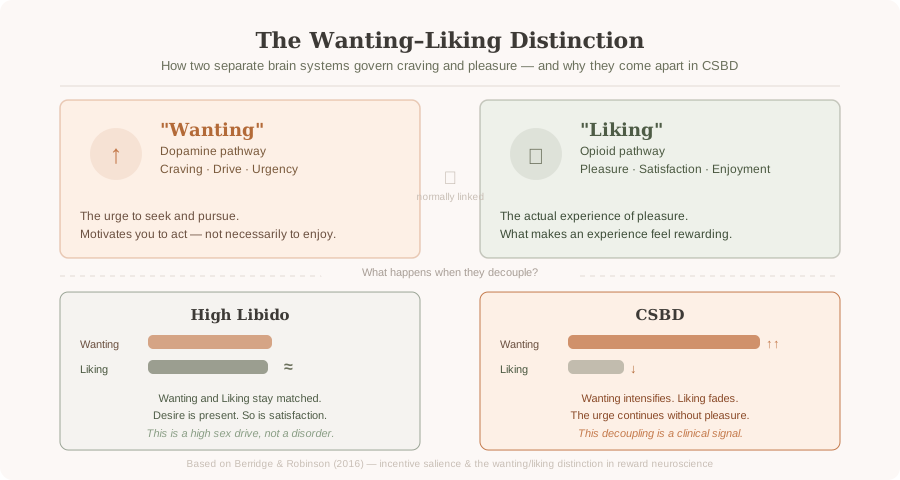
Research applying this to CSBD confirms the dissociation: individuals with compulsive sexual behavior show high levels of "wanting" that are not matched by equivalent "liking." They continue despite deriving diminishing or no satisfaction. A high libido, by contrast, is characterized by genuine desire for, and genuine pleasure from, sexual experience.
If the pleasure is gone and the urge remains, that shows, the person needs help.
The third question is: Is your life actually being harmed?
A 2020 analysis in the Journal of Behavioral Addictions is explicit: "If a high sex drive does not cause distress or if the distress is only mediated by negative social norms, individuals with a high sex drive should not be pathologized." The clinical test is not what you do, or how often, or how much you want it. It is whether the behavior is causing objective damage to your life: broken relationships, lost employment, financial harm, physical risk, violation of your own clearly held values.
Feeling embarrassed about your sex drive is not functional impairment. Canceling important commitments repeatedly to act on compulsions is.
The Moral Incongruence Problem
There is a well-documented phenomenon in the clinical literature called moral incongruence: the experience of distress that comes not from loss of control, but from the conflict between a person's behavior and their moral or religious beliefs about that behavior.
Research by Grubbs and Perry (2020), studying 2,519 participants, found that moral incongruence was a stronger predictor of self-reported sexual addiction than actual behavior frequency. In other words, the people most likely to believe they had a sexual addiction were not necessarily the people who had lost control. They were the people who felt the most moral conflict about behavior that was, in clinical terms, within their control.
In a nationally representative sample, 11% of men and 3% of women described themselves as addicted to pornography. The actual prevalence of CSBD (which requires demonstrable loss of control and functional impairment) is estimated at 2–8% of men and 2–7% of women globally. The gap between self-reported "addiction" and clinical diagnosis is, in a significant portion of cases, moral incongruence.
The treatment for moral incongruence is different from the treatment for CSBD. Genuine CSBD requires work on behavioral control, impulse regulation, and often the underlying emotional needs the behavior is serving. Moral incongruence requires work on the shame itself, on the beliefs (often internalized from culture or religion) that tell a person their normal sexuality is evidence of something wrong with them.
Treating moral incongruence as CSBD does not help. It deepens the shame, reinforces the false self-diagnosis, and delays the actual work: examining whether the cultural messages about sexuality that a person has absorbed are accurate.
The South Asian Context
I want to speak directly to this, because I see it in my practice.
South Asian communities, whether in India, the UK, the US, Sweden, or anywhere in the diaspora, carry a specific inheritance around sexuality. Research on sharam and izzat documents how shame and family honor are actively deployed as mechanisms of sexual control, particularly for women, but extending to men and young people of all genders.
Data from India shows that 82% of Indian women perceive themselves to have at least one sexual disorder, that 64% cannot discuss sexual matters with their partners, and that only 19% of Indian adolescents receive any comprehensive sexual education. These numbers reflect a culture in which normal sexual experience is consistently framed as problematic.
In this environment, moral incongruence is not an edge case. It is the default. A South Asian person who experiences a high libido, who uses pornography, or who has sexual desires their community would disapprove of, is operating in a cultural context that pathologizes normal sexuality. The distress is real. The shame is real. But it is not evidence of CSBD.
What CBT Actually Does Here
Cognitive Behavioral Therapy (CBT) is the most evidence-based approach for CSBD, and it is also well-suited for disentangling CSBD from moral incongruence because it begins with a precise question: where is the distress coming from?
CBT for genuine CSBD addresses the loss of control directly: identifying triggers, building impulse regulation skills, addressing the underlying emotional needs (often loneliness, stress, or emotional avoidance) that the behavior is serving. The goal is not shame reduction. It is behavioral change.
CBT for moral incongruence looks different. Here, the work is examining the beliefs themselves: Is this behavior actually harmful? Is it aligned with your own values (not your community's values, not your parents' values, but yours)? Are you distressed because you are out of control, or because you have absorbed the message that your normal sexuality is wrong?
Standard CBT components for CSBD include psychoeducation, awareness of emotional triggers, self-regulation training, and relapse prevention. For moral incongruence, the psychoeducation component is especially important: understanding that the ICD-11 explicitly protects against pathologizing normal sexuality is, for many people, the most clarifying thing they have ever heard about their own experience.
Practical Steps: Before You Self-Diagnose
If you are reading this because you are not sure whether what you experience is a high libido or a problem worth addressing, here are five steps that will give you more clarity than any checklist:
1. Ask the control question honestly. Not: "Have I ever felt unable to stop?" but: "When I genuinely needed to stop, was I able to?" If the answer is yes, consistently, that is important information.
2. Track whether pleasure is present. For one week, notice whether your sexual activity is something you genuinely enjoy, or whether you are going through motions you cannot stop even when the satisfaction is gone. The presence or absence of pleasure matters clinically.
3. Assess actual impairment. List any concrete, objective harms the behavior has caused in the last six months: relationships ended because of it, work affected, finances damaged, health risked, clearly held personal values violated. Not embarrassment. Not guilt. Actual harm.
4. Separate cultural distress from behavioral distress. Ask yourself: if you had grown up in a culture with no shame about your sexuality, would this behavior feel like a problem? If the honest answer is no, you may be working with cultural conditioning rather than compulsive behavior.
5. Talk to someone who knows the difference. A therapist or coach who works in sexual health can help you make this distinction accurately. Arriving with the question is enough. You do not need to arrive with the diagnosis.
You May Not Have What You Think You Have
I work with people across many cultures and backgrounds, and one of the most common things I do is not diagnose. It is un-diagnose: help a person understand that the twelve years of self-labeling, the years of treating themselves as broken, were built on shame, not on clinical reality.
That is not a small thing to undo. But it is undoable.
If you are carrying a self-imposed diagnosis, ask where it came from. Whether it reflects a genuine loss of control and real harm, or whether it reflects what you were taught to believe about your own sexuality.
Both self-diagnosis of sex addiction based on high sexual libido and the addiction itself deserve attention. They both need separate types of therapy.
✦ Written with AI Assistance
The research and initial draft for this article were developed using Claude by Anthropic. Dr. Swapna Vithalkar reviewed and shaped the final content.