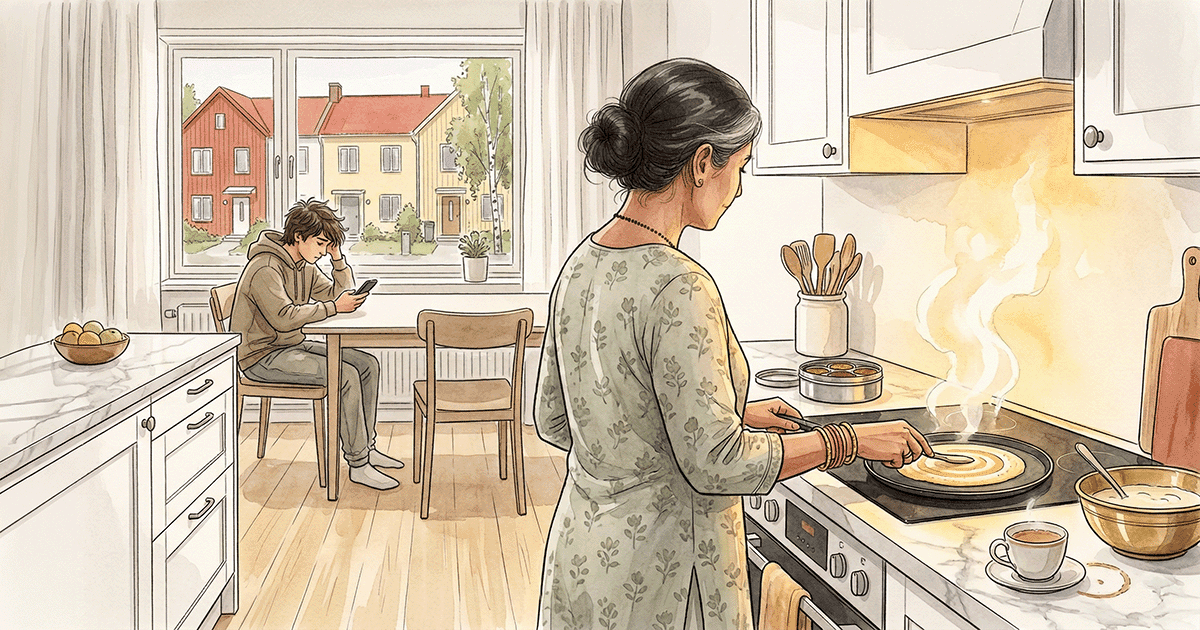
It is Sunday morning in Stockholm, and she is making dosas for breakfast.
Later, there will be a birthday party where her daughter will eat cake and sing in Swedish. And later still, a video call with her mother in Mumbai, who will ask why the children do not speak better Hindi. Why do they not understand respect? Why do they call their grandparents by their first names? She hangs up feeling like she is failing on both sides.
In another household, a couple are talking about why Swedish schools don't assign homework, while their friend's four-year-old in India can already write the entire alphabet and their own child, born in Sweden, cannot. They are also uncomfortable about the communal changing rooms at the local pool, where adults and children shower together without clothing, a situation that prompts questions many parents feel unprepared to answer.
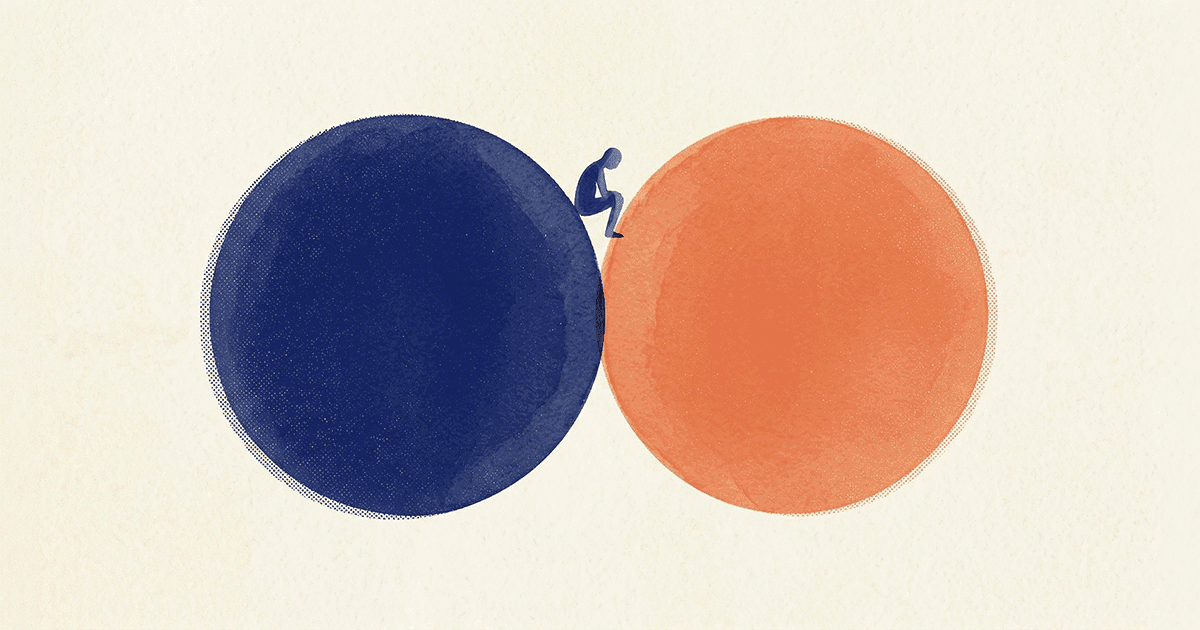
This is the life of Indian mothers raising children abroad, caught between two worlds, held responsible for preserving one culture while helping their children thrive in another. And often, no one asks about the toll this takes. No one sees the mental load she carries just to keep both worlds in balance.
The Weight No One Sees
The statistics tell part of the story. Research on Asian Indian immigrant women in the US found that 28% experienced minor depressive symptoms and an additional 24% experienced major depressive symptoms postpartum. A systematic review found that immigrant women were twice as likely to experience depressive symptoms in the postpartum period compared to non-immigrant women.
But postpartum depression is only one part of the picture. Research on parental burnout shows that 65% of working parents report burnout, with depression, anxiety, and a history of mental health concerns significantly correlated with parental exhaustion. For immigrant mothers specifically, research shows that mental load ascends at the beginning of the migration journey, and often it never fully recedes.
And yet, despite these high rates of distress, service utilization among immigrants ranges from only 5-40% for those with a psychiatric diagnosis, and 3-6% for those without, well below the national average. When stigma is measured directly, 33% of immigrant women cite it as a barrier to seeking help.
The message is clear: many mothers are struggling in silence.
The Invisible Labor of Cultural Transmission
What makes the mental load of immigrant motherhood unique is that it goes beyond the standard challenges of raising children. It is the added responsibility of being the keeper of culture, the person expected to pass down language, traditions, values, and a sense of belonging to a place your children have never lived.
Research on cultural transmission shows that immigrants have a strong culture-transmission motive (a deep desire to maintain their culture of origin and pass it to the next generation). But this is not a passive inheritance. It requires active, daily labor.
As one study on immigrant women's emotional labor puts it: "Immigration itself is often an act of emotional labor." Mothers are rearing their children, teaching them languages, taking them to the doctor, building community, cooking the food of their countries, creating and maintaining family traditions, all while navigating a society that is not designed for them.
Historically, mothers have been the primary transmitters of language. They safeguard cultural memory. They contribute to the cultural survival of culinary practices, folklore, and healing traditions. For Indian mothers abroad, this might mean enrolling children in weekend Hindi classes, hosting Diwali celebrations for families who have no extended relatives nearby, or explaining to a teacher why a child fasts for Navratri.
A study on mothers abroad describes it as "balancing tradition with modernity," an age-old issue, but one intensified by geographic and cultural distance. Indian mothers are finding ways to educate their children about their heritage while helping them succeed in Western society. They are answering questions like: Which cultural values do we preserve, and which do we adapt?
The mental gymnastics required for this work is exhausting. And it is largely invisible.
Walking the Tightrope: Collectivism vs. Individualism
Perhaps the deepest tension immigrant Indian mothers face is the clash between collectivist Indian values and individualist Western values.
In Indian joint family systems, the self is largely defined through collective identity. Family identity forms a significant component of self-identity. The focus is on family integrity, loyalty, and unity, often at the expense of individuality, freedom of choice, and personal space.
But children growing up in Western countries absorb individualist values through school, media, and peers. Personal decisions like dating preferences and career choices become more personal and less dominated by family influence. As one researcher puts it, this creates questions like: "Do I pursue a career passion my parents are wary of? Do I date someone outside my culture?"
Research on intergenerational cultural dissonance shows that this clash between parents adhering to traditional cultural beliefs and children endorsing dominant Western values is a frequent source of conflict in Asian American families. The mental health consequences are significant: every one-point increase in parent-child conflict was associated with children being 2.31 times more likely to experience stress and 4.56 times more likely to experience loneliness.
This is not just a philosophical disagreement. It is a daily negotiation over identity, belonging, and values, and mothers are often caught in the middle, trying to mediate between their children's evolving identities and their own parents' expectations from across the world.
Third Culture Kids
When children are raised between cultures, they often become what researchers call Third Culture Kids (TCKs), people who spend significant developmental years outside their parents' culture and build relationships to all cultures while not having full ownership of any.
Research on TCKs shows they can experience identity confusion, loneliness, and difficulty maintaining friendships in both host and home countries. The battle between East and West cultural values is one of the biggest factors leading to difficult transitions.
But the research also shows a crucial protective factor: positive relationships with parents are critical in helping TCKs achieve a strong multicultural identity rather than a confused one. When mothers successfully navigate both cultures, they become acculturation role models for their children. When immigrant mothers adopt integrated attitudes toward both their country of origin and the host country, their children have higher bicultural acceptance and lower acculturative stress.
In other words: how you, as a mother, hold the tension between cultures directly shapes how your children will hold it.
The Loneliness of the Nuclear Family
One of the most painful losses for Indian mothers abroad is the shift from extended family support to nuclear family isolation.
In India, the joint family system provides built-in support. A woman faced with the crisis of a sick baby has an experienced mother or mother-in-law nearby to offer advice. Grandparents, aunts, uncles, and cousins play active roles in raising children and providing emotional support.
Abroad, that buffer disappears. Research on migrant mothers describes social isolation as the loss of family support and familiar social and cultural networks. Most women are far from extended families and turn to mothers' groups or church for social support, but these are not the same as the intergenerational, familial safety net they left behind.
The consequences are measurable. Social isolation among migrant women is associated with stress, depression, postpartum depression, low self-esteem, and reduced sense of parental competence. Research comparing family structures found that adolescents from joint families have better mental health than those from nuclear families, and elderly living in joint families had better social support and quality of life.
When migrant mothers are alone to care for their children, it limits time for self-development: language classes, employment, building community, all things that would help them overcome some of the barriers contributing to their isolation.
It is a cycle: isolation makes adaptation harder, and difficulty adapting deepens isolation.
What Actually Helps
Research shows clear pathways to resilience.
1. Bicultural integration, not assimilation. Studies on acculturation show that mothers who integrate both cultures (participating in their heritage culture and the mainstream culture) experience fewer depressive symptoms than those who only participate in one or the other. Bicultural integration is linked to positive mental health, self-esteem, optimism, and better parent-child communication.
You do not have to choose. You can honor both.
2. Learning the local language. Learning the local language leads to meaningful benefits for integration:
- Developing competence in the host country's language (while ideally maintaining the native language through dual language acquisition) has long-term benefits for children's educational adaptation, cognitive development, and mental health (Toppelberg & Collins, 2010).
- The wage gap between immigrants and local workers often narrows significantly, improving integration outcomes (Daley et al., 2019).
- Host country language skills are critical for highly educated immigrants to find work in their original professions, preventing what researchers call "brain waste" (Zorlu & Hartog, 2018).
- A greater local supply of language courses significantly increases employment probabilities for immigrants, preventing long-term marginalization (Kanas & Kosyakova, 2022).
- Language is an essential link in the social integration process, directly influencing an immigrant's ability to engage with native speakers and participate in local culture (Akresh et al., 2014).
3. DBT and mindfulness-based interventions. Culturally adapted DBT programs for caregivers have shown significant results: decreased perceived stress, increased mindfulness in parenting, increased emotion regulation, and decreased child behavioral difficulties. Mindfulness-based interventions perform comparably to CBT and help mothers manage parenting stress through psychoeducation, imagination exercises, and mindful parenting practices.
4. Self-compassion. Research on self-compassion shows that learning to be compassionate with yourself in the face of inadequacy resonates across cultures. Self-compassion helps you step out of over-identification with your "failings" and recognize that you are stumbling, learning, and doing your best.
When you judge yourself for not being Indian enough or not being Western enough, self-compassion asks: What if both are true, and that is okay?
5. Community support. Organizations like SAMHAJ (South Asian Mental Health Awareness in Jersey) provide culturally competent outreach and help immigrant families navigate the mental health system. Finding or building community, even online, with other mothers walking this same tightrope can break the isolation.
6. Normalize the complexity. Your children will not grow up exactly as you did. That is not failure. That is immigration. Research on bicultural identity integration shows that when children see their two cultural identities as compatible rather than oppositional, they thrive. You model that compatibility (or that opposition) through how you navigate it yourself.
You Are Doing More Than You Know
If you are reading this and recognizing yourself, I want you to know: the work you are doing is monumental. You are raising children who will carry two cultures, two languages, two ways of seeing the world. You are creating a bridge between generations and geographies.
That work is exhausting. It is often invisible. And it is deeply valuable.
You do not have to do it perfectly. You do not have to preserve every tradition or meet every expectation. What your children need most is a mother who is present, who is kind to herself, and who shows them that it is possible to belong to more than one world at once.
✦ Written with AI Assistance
The research and initial draft for this article were developed using Claude by Anthropic. Dr. Swapna Vithalkar reviewed and shaped the final content.