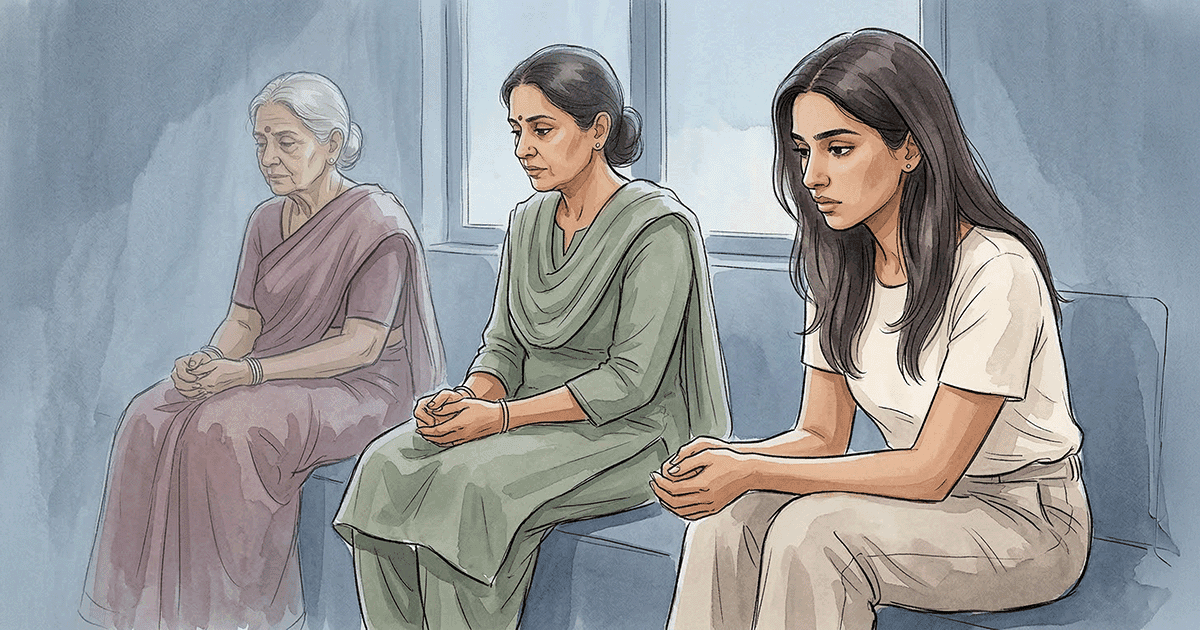
Sheetal wakes at 3 AM, heart pounding, scanning for danger that isn't there. Her mother did this too. And her grandmother before that. Three generations of women, lying awake in the dark, bodies tense with a vigilance they cannot name.
When I ask her what she is afraid of, she says, "I don't know. I just feel like something bad is going to happen." This is not anxiety born from her own life. This is anxiety she inherited.
Rohini gets a panic attack every time she gets criticised by her husband, when she gets negative feedback from her boss, when her friend blames her for not doing the work she promised to do. She starts crying whenever she understands that someone is getting irritated or burdened due to her misprioritization. She finds it difficult to stop crying. This problem was aggravated after the untimely death of her father in a rehabilitation centre. Her father started a drinking problem when his mother committed suicide. Now Rohini is undergoing a difficult divorce process as her unresolved trauma is affecting the relationship.
In my two decades working with women from South Asian backgrounds, I have seen this pattern repeat again and again. The body remembers what the mind has forgotten. Trauma does not always announce itself with a clear narrative. Sometimes it arrives as chronic worry, as a tightness in the chest when nothing is wrong, as an inability to rest even when you are safe.
This article is about generational trauma: how pain travels through families, how it shows up in your body and thoughts, and how you can begin to put down what was never yours to carry.
What is generational trauma?
Generational trauma, also called intergenerational trauma, refers to psychological and emotional wounds transmitted from one generation to the next, often without conscious awareness. It creates patterns of behavior, beliefs, and emotional responses that get passed down through families and communities.
The science here is both biological and relational. Research published in PMC shows that trauma can be transmitted through epigenetic mechanisms, changes in gene expression that influence how vulnerable or resilient we are to stress. This research is based upon animal models. A study of three generations of Syrian refugees found 32 epigenetic sites showing similar changes in DNA methylation across all exposure types, suggesting a common biological signature of violence across multiple developmental stages.
But trauma does not travel through genes alone. It travels through attachment patterns. Through the way your mother held you when she was afraid. Through the lessons she taught you about safety and trust, through the parenting style that she thinks is best, all shaped by her own unhealed wounds.
A study published in Frontiers in Psychology found that mothers with unresolved trauma often struggle to respond sensitively to their infants. Elevated maternal PTSD symptoms at six months were associated with increased risk for insecure or disorganized attachment at 13 months. The attachment strategy often reverses, such that mothers with preoccupied attachment tend to have infants who use avoidant strategies, and vice versa.
For Indian women specifically, the statistics are evident. According to SAPHA, 1 in 5 US South Asians report experiencing a mood or anxiety disorder in their lifetime, with women reporting higher levels of distress than men. A 2025 study in Delhi-NCR found that 72.3% of young adults reported at least one Adverse Childhood Experience (ACE), with 17% reporting four or more. Exposure to ACEs increased the odds of moderate to severe depression, anxiety, and high stress in a dose-response manner.
And yet, the National Mental Health Survey of India documented a treatment gap of 70-92% for different mental disorders. Only 10-12% of sufferers seek help, largely due to stigma.
How generational trauma shows up in Indian women
Trauma does not always look like trauma. In Indian families, it often wears the mask of normal.
The silence around suffering
A study on stigma found that while 87% of Indians showed awareness of mental illness, 71% also used stigmatizing terms. Nearly 80% had never heard of schizophrenia or bipolar disorder. Mental illness is framed as a sign of weakness, a personal failure, or in many communities as something caused by supernatural forces, karma, or witchcraft.
This creates a cycle. The mother who suffered in silence teaches her daughter to do the same. Not explicitly, but through example. You learn early: do not speak of your pain. Do not burden others. Adjust. Manage. Endure.
Research published in PMC documents how emotional suppression is gendered in Indian families. Boys learn that aggression and emotional detachment are acceptable; girls are taught to bear their pain silently. This suppression does not make the pain go away. It gets channelised inward, where it manifests as anxiety, depression, chronic guilt, and somatic symptoms.
Enmeshment and the erasure of self
In South Asian families, emotional enmeshment (merging personal interests with others) is often the norm. As one article on Burnt Roti puts it: setting boundaries can feel like inviting a lecture on "family first."
Enmeshment involves a reversal of the typical parent-child dynamic. The child takes on the parent role; the mother becomes more like the child. This creates people-pleasing behavior, low self-esteem, intense guilt and shame, hypervigilance, identity crisis, and heightened anxiety at separation from the mother. These patterns are passed down trans-generationally.
I see this in my sessions constantly. Women who cannot make a decision without consulting their mother and their partner. Women who feel physically sick when they disappoint their family. Women who do not know who they are outside of the roles they perform. Women who rely on the interpretations of the events drawn by husband or father, then internalise and project them as their own.
The body keeps the score
What often goes unrecognized is how generational trauma shows up in the body. Research on trauma and attachment found that women with childhood maltreatment had markedly decreased levels of oxytocin, a neuropeptide that helps manage stress and anxiety. More childhood traumas correlated with lower oxytocin levels and higher anxiety.
Trauma sensitizes the body. It makes hypervigilance and somatic anxiety more likely. In many ethnic and cultural backgrounds, emotional distress is often expressed through physical symptoms rather than emotional language. Heart-related idioms like "Dil baith jana" (pain in the heart), "Ruh kaap uthna" (getting shaken up), "zinda laash banana" (feeling like dead) appear across trauma contexts in Indian and Middle Eastern communities.
If you wake with a racing heart for no reason, if your shoulders carry tension you cannot release, if your stomach tightens when the phone rings, your body may be responding to a threat your conscious mind does not remember. But your nervous system does.
The weight of history
For many Indian families, trauma has a specific historical root: the Partition of 1947. The largest mass migration in human history displaced 12-20 million people and triggered widespread violence. Both survivors and their descendants score in the medium range for intergenerational trauma.
Trauma from Partition shows up as scarcity mindset, anxiety and fear of loss, cultural disconnection, shame, and secrecy. Descendants report hypervigilance, mistrust, high anxiety, insomnia, low self-esteem, nightmares, panic attacks, depression, and difficulty with relationships. Research published in ScienceDirect proposes integrating a historical trauma perspective into public health research on South Asian immigrants, who show disproportionately high rates of cardiometabolic diseases and mental conditions.
The Parent ego state: a transactional analysis lens
In my practice, I often use some concepts of Transactional Analysis (TA), a framework developed by Eric Berne that helps people understand the different modes in which they think, feel, and behave. TA identifies three ego states: Parent, Adult, and Child.
The Parent ego state is where inherited scripts live. It holds the rules, values, and attitudes learned from authority figures, formed between birth and age 20. Research on TA and intergenerational trauma shows that each person is both an individual and a carrier of dynamics from many generations of ancestors. Many people hold trauma that originally belonged to other family members or the family group.
When you hear a voice in your head saying, "You are being selfish," or "What will people say?" that voice is often your Parent ego state. Not your actual parent, but the internalized parent: the collection of beliefs, rules, and fears you absorbed before you had the critical thinking to question them.
The work is not to eliminate the Parent ego state. It is to become aware of it. To ask: Is this belief mine, or is this something I inherited? When you feel anxious, is it because of something happening now, or because your nervous system learned to be vigilant from watching your mother's anxiety?
Breaking the cycle: what actually helps
Generational trauma can be interrupted. You do not have to pass it on.
1. Name what you are carrying. When you feel anxious, pause and ask: Is this mine? If the fear feels disproportionate to the situation, it may be inherited. Naming it out loud ("This is my grandmother's fear, not mine") creates distance.
2. Work with a trauma-informed therapist. Trauma-Focused CBT (TF-CBT) is evidence-based for processing traumatic experiences. DBT-PTSD, a phase-based intervention, helps manage intense emotions. Both frameworks train you to recognize self-defeating narratives and replace them with perspectives rooted in reality, not fear.
3. Reclaim your body. Generational trauma lives in the body. Practices like mindfulness, somatic therapy, yoga, and breathwork help you re-regulate your nervous system. Research on coping mechanisms emphasizes staying grounded and present, which reduces the impact of past trauma on current life.
4. Set boundaries, even when it feels like betrayal. Enmeshment teaches you that boundaries are selfish. They are not. Boundaries are how you protect your mental health while still honoring your family. You can love your mother and still refuse to absorb her anxiety.
5. Break the silence. As research on Indian mothers documents, some are choosing to speak openly about mental illness, postpartum depression, abuse, sexuality, and identity. "A daughter who sees her mom speak up about mental health will never believe therapy is shameful." Your healing makes it easier for the next generation.
You can put it down
Generational trauma is not your fault. You did not create it. But you have the power to stop carrying it.
The anxiety you feel at 3 AM may not be yours. The hypervigilance, the guilt, the fear of disappointing others. These may be patterns passed down through generations of women who had no other choice but to endure.
You have a choice now. And choosing to heal is not a rejection of your family or your culture. It is an act of love, for yourself and for the generations that come after you.
✦ Written with AI Assistance
The research and initial draft for this article were developed using Claude by Anthropic. Dr. Swapna Vithalkar reviewed and shaped the final content.