Client A books the appointment for "relationship coaching." Not anxiety. She is tired of the daily conflicts, fault-finding, and blame, and wants her husband to join our sessions. Client B runs a team, raises two children, calls her parents every Sunday, volunteers for the school committee, and has not missed a deadline in eleven years, but feels overwhelmed by all the responsibilities and thinks her husband doesn't understand her. Client C wants to learn how to handle her teenager and her husband, who constantly argue with each other. She feels helpless and wants to deal with the situation better.
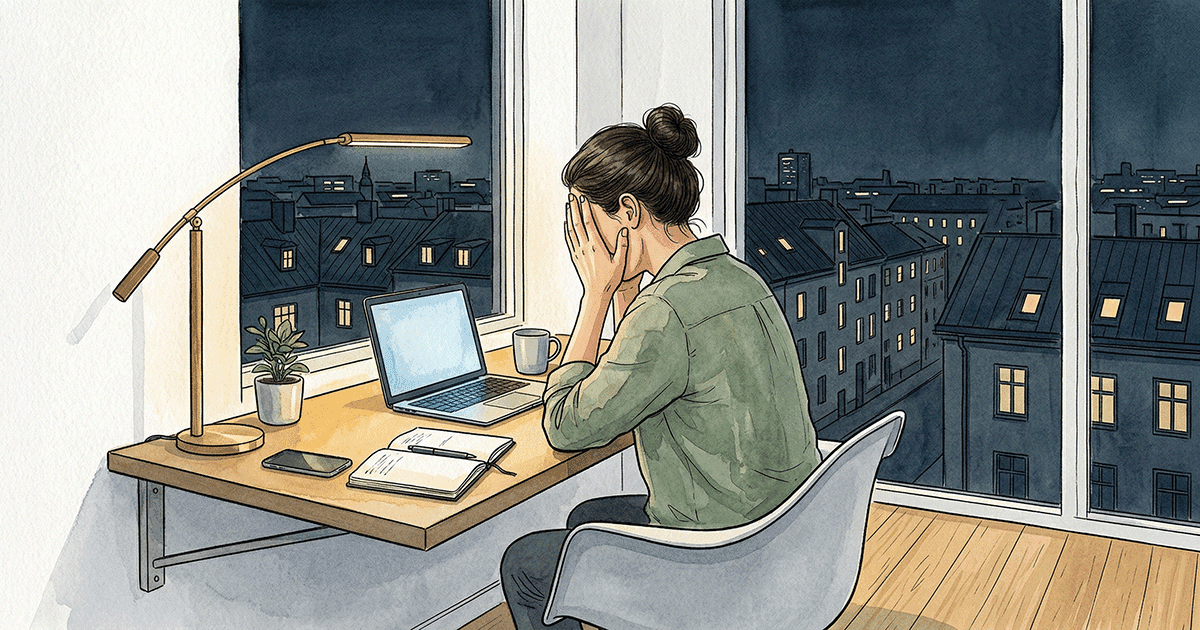
In the session, all of them tell me they are sleeping less, worrying more, always checking that they haven't missed anything important. They say they cannot switch off, and feel like they are always waiting for something to go wrong.
"But I'm fine," they add quickly. "I'm managing."
I have heard this so many times in my sessions. The language changes: stressed, overwhelmed, a bit wound up, but the pattern is the same. Women arrive describing anxiety in every word except that one.
And the research confirms exactly what I see in practice: anxiety has a female face. It is the most common mental health condition affecting women globally, and one of the least recognized.
The Numbers Make It Undeniable
Across virtually every study, every country, and every type of anxiety disorder, women are diagnosed at approximately twice the rate of men.
Research published in PMC documents that women experience a 23.4% annual anxiety prevalence compared to 14.3% in men. Lifetime figures are even larger: 30.5% of women will meet criteria for an anxiety disorder at some point in their lives, compared to 19.2% of men (PMC, 2022). In England in 2023-2024, 24.2% of women had a common mental health condition versus 15.4% of men (Psyhccare, 2024).
The gap holds across every disorder type. For Generalized Anxiety Disorder (GAD), the 12-month female-to-male ratio is 1:2.2 (ADAA). For panic disorder, 5.0% of women are affected compared to 2.0% of men (Herald Open Access). For PTSD, women are twice as likely to develop it following trauma (South Denver Therapy, 2026).
And the gap is widening. Norwegian longitudinal data tracking adolescents from 1992 to 2019 found that mental health problems increased 17% among females but only 5% among males over 27 years. Girls are more anxious than boys, and becoming more anxious faster.
Despite this, the average delay between anxiety symptom onset and treatment is 11 years. And only 43% of women with a mental health condition received therapy in the past year (South Denver Therapy, 2026).
Eleven years. That is a long time to manage something alone.
Why Women? The Biology and the Socialization
The gender gap in anxiety has two intertwined explanations: what happens in the body, and what happens in the world.
The Body
The female stress response system works differently from the male one, and not in a way that protects against anxiety.
Research on the HPA (Hypothalamic-Pituitary-Adrenal) axis, the body's central stress system that controls cortisol release, shows that women demonstrate a more robust neuroendocrine response to acute stress: higher cortisol and ACTH levels, and a delayed return to baseline after a stressful event. The stress response activates faster and lingers longer.
Estrogen plays a central role. Estradiol enhances HPA axis activity, amplifying the stress response. When estrogen drops (at puberty, premenstrually, postpartum, and during perimenopause), mood-regulating chemicals including serotonin and dopamine become disrupted. This is why anxiety is disproportionately elevated during these life stages. Johns Hopkins Medicine documents that the brain's amygdala "reacts to extreme changes in estrogen levels," which causes heightened threat reactivity during hormonal transitions.
Women who have never experienced anxiety in their lives can find themselves anxious for the first time in perimenopause. Women who were managing well can find everything unravel postpartum. This is not weakness. It is biology encountering a changing hormonal environment without adequate support.
The Socialization
Biology alone does not explain everything. Research identifies a striking finding: "Masculinity may be a protective factor for anxiety development, while femininity can be a risk factor."
This is not about gender identity. It is about the traits girls are systematically socialized into. As the research documents: "Girls are encouraged throughout socialization to express fears and worries and oriented toward dependence and fearfulness, while boys are taught to contain fear and insecurity."
From childhood, girls learn to be emotionally attuned to others: to read the room, anticipate needs, smooth over conflict. These skills are valuable. But they are also the building blocks of hypervigilance: the constant scanning of the environment for threats to others' wellbeing. Combined with the weight of emotional labor (the invisible work of managing family relationships, workplace dynamics, and cultural expectations simultaneously), this creates a sustained physiological state of alertness that the nervous system eventually struggles to distinguish from danger.
Girls are also more likely to develop rumination (repetitive negative thinking about problems rather than active problem-solving) and avoidance coping, which research identifies as a key mechanism explaining the gender disparity in anxiety prevalence. Avoidance offers short-term relief but keeps anxiety alive long-term.
What Anxiety Actually Looks Like in Women
Anxiety does not always look like panic. In women especially, it often looks like competence.
High-Functioning Anxiety: The Hidden Presentation
High-functioning anxiety is not a formal clinical diagnosis, but it describes something I see constantly in practice. Externally: organized, reliable, high-performing, always prepared. Internally: relentless worry, difficulty switching off, an inability to enjoy achievements because the next task is already pressing in.
Research on high-functioning anxiety identifies exactly why it goes unrecognized: "This invisibility stems from society's tendency to praise the behaviors that often mask anxiety: perfectionism, overachievement, and constant busyness."
For many ambitious women, perfectionism is not a personality trait; it is a trauma response. "A way of staying in control when things once felt out of control and a way of trying to earn love, approval, or safety by being 'good,' 'easy,' or 'impressive.'"
When the behaviors that manage your anxiety are the behaviors being praised, you stop seeing them as symptoms. You see them as strengths. And so does everyone around you.
Somatic Symptoms and Misdiagnosis
Anxiety in women also frequently presents through the body. Chest tightness. Persistent headaches. Stomach problems. Fatigue that no amount of rest resolves. Muscle tension in the jaw and shoulders.
When women bring these symptoms to their doctor, two things happen that should alarm us. First, the symptoms are sometimes dismissed as "anxiety" or "hormonal" when they are actually medical. Second, when the anxiety itself is the real issue, physicians may investigate physical causes for months before a psychological referral is made.
Research published in Undark (2024) found that women are 66% more likely to face medical misdiagnosis than men. More disturbing: research in the European Heart Journal Digital Health found that GPT-4o, the AI diagnostic tool increasingly used in healthcare settings, more frequently attributed female patients' cardiovascular symptoms to anxiety or panic disorder, encoding existing gender bias into emerging technology.
The system is not designed to find anxiety in women who appear to be managing. It is designed to find it in women who appear to be falling apart.
The South Asian Layer
For South Asian and Indian women, the gender gap in anxiety compounds with cultural and structural factors that make the situation more acute.
UK research found that Indian women face a 2.80x elevated risk for depression and anxiety compared to the general population. For Pakistani women, the risk rises to 3.15x. In India, the National Mental Health Survey found women are 1.67x more likely than men to have an anxiety disorder, with a treatment gap of 82.9%. Nearly five in six women who need care do not receive it.
The barriers are well-documented. South Asian communities express greater stigma toward mental illness than other groups. Disclosure is feared to bring shame upon the family. Seeking help is framed as a failure of strength, and for women specifically, a failure of the caregiver role. Research notes that "marked gender discrimination in South Asia has led to second-class status of women in society, with their mobility, work, self-esteem, and identity depending upon male members of a patriarchal society." Those are conditions that directly generate anxiety while blocking the path to treatment.
South Asian women also frequently present anxiety as physical symptoms: sleep problems, bodily pain, gastrointestinal distress, making it harder for both the woman and her doctor to name what is actually happening.
Research on South Asian explanatory models of mental illness shows that professional mental health support is often the last resort, sought only after private coping, prayer, and family advice have been exhausted. The average treatment delay in the West is 11 years. For South Asian women, cultural and structural barriers often make it longer.
What Actually Helps
Anxiety responds well to treatment. The evidence base is solid.
CBT: The Gold Standard
Cognitive Behavioral Therapy (CBT) has the strongest evidence for anxiety across all disorder types. A meta-analysis of 52 trials on CBT for GAD, with 69.7% female participants, confirmed individual CBT is superior to control conditions. The overall effect size across anxiety disorders is Hedges' g = 0.51 (PMC, 2022), clinically meaningful and durable. A 2025 analysis confirmed CBT effect sizes for anxiety have remained stable over 30 years.
For women's anxiety specifically, the most relevant CBT techniques are:
Cognitive restructuring: Directly targets the rumination and catastrophizing patterns more common in women. When the mind spirals ("What if I made the wrong decision? What if they think I'm incompetent? What if something goes wrong?"), CBT helps you evaluate the evidence. Not to dismiss the worry, but to stop treating it as fact.
Exposure and behavioral experiments: For women who manage anxiety through avoidance (avoiding conflict, avoiding social risk, avoiding situations that might lead to judgment), exposure therapy gradually dismantles the avoidance while demonstrating that the feared outcomes rarely materialize.
Imaginal exposure for GAD: Writing and sitting with worst-case scenarios prevents the mind from treating vague catastrophes as more manageable than specific ones. Naming the fear precisely is often the beginning of reducing its power.
REBT: Challenging the Beliefs Behind the Anxiety
My own work draws significantly on Rational Emotive Behaviour Therapy (REBT), which targets the irrational beliefs that drive anxiety's intensity. A 2024 systematic review of 93 REBT intervention studies found that 71% reported statistically significant improvements for REBT participants versus controls.
Women's anxiety is often sustained by specific "must" beliefs:
- "I must be approved of by everyone important to me."
- "I must do everything perfectly or I am a failure."
- "Other people's needs are more important than mine."
- "Something terrible will happen if I stop being vigilant."
REBT does not ask you to simply think more positively. It asks you to interrogate whether these beliefs are logical, helpful, or based on evidence, and to replace demands with preferences. The shift from "I must never make a mistake" to "I would prefer not to make mistakes, and if I do, I can handle it" is the distance between chronic anxiety and genuine coping.
DBT: Skills for When Anxiety Escalates
Dialectical Behavior Therapy (DBT) skills offer practical tools for managing anxiety in the moment, particularly when emotion dysregulation is involved. Research confirms that DBT skills training may be an effective alternative or complement to CBT for GAD, especially with complex comorbidities.
The four DBT skill modules each address something specific in women's anxiety:
- Mindfulness counters rumination by anchoring attention in the present
- Distress tolerance offers skills (paced breathing, cold water, movement) that interrupt the physiological escalation of anxiety
- Emotion regulation builds the capacity to name and process anxiety rather than react to it
- Interpersonal effectiveness directly addresses the relational anxiety and fear of asserting needs that characterizes many women's experience
If You Recognize Yourself Here
The women I described at the beginning of this article, managing everything, sleeping less, calling it stress rather than anxiety, eventually came to understand how their own anxiety was shaping the relationship dynamics around them. Their partners came to understand it too: how to support their wives during those moments when anxiety takes over.
If you recognize yourself in what you have read, in the high-functioning presentation, the somatic symptoms, the reluctance to name it, I want to offer you the question my clients asked themselves: What would it mean to stop managing anxiety and actually address it?
The answer, for most women, involves relief and self-confidence. Relief that there is a name for what they have been carrying, and respect that they are equipped to deal with it.
✦ Written with AI Assistance
The research and initial draft for this article were developed using Claude by Anthropic. Dr. Swapna Vithalkar reviewed and shaped the final content.