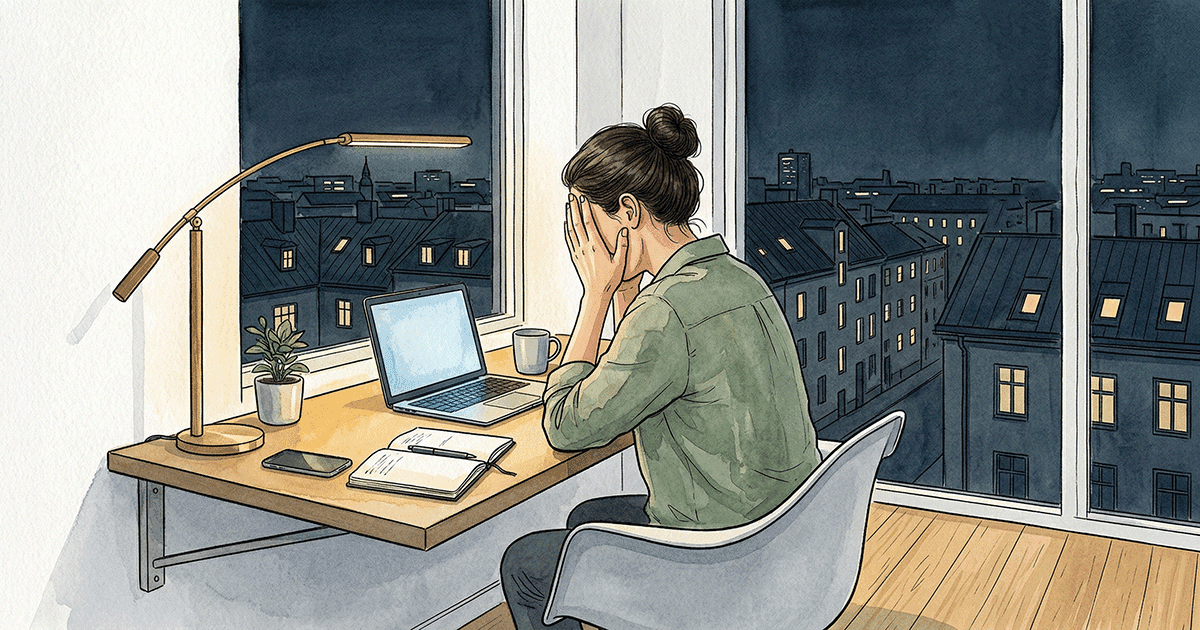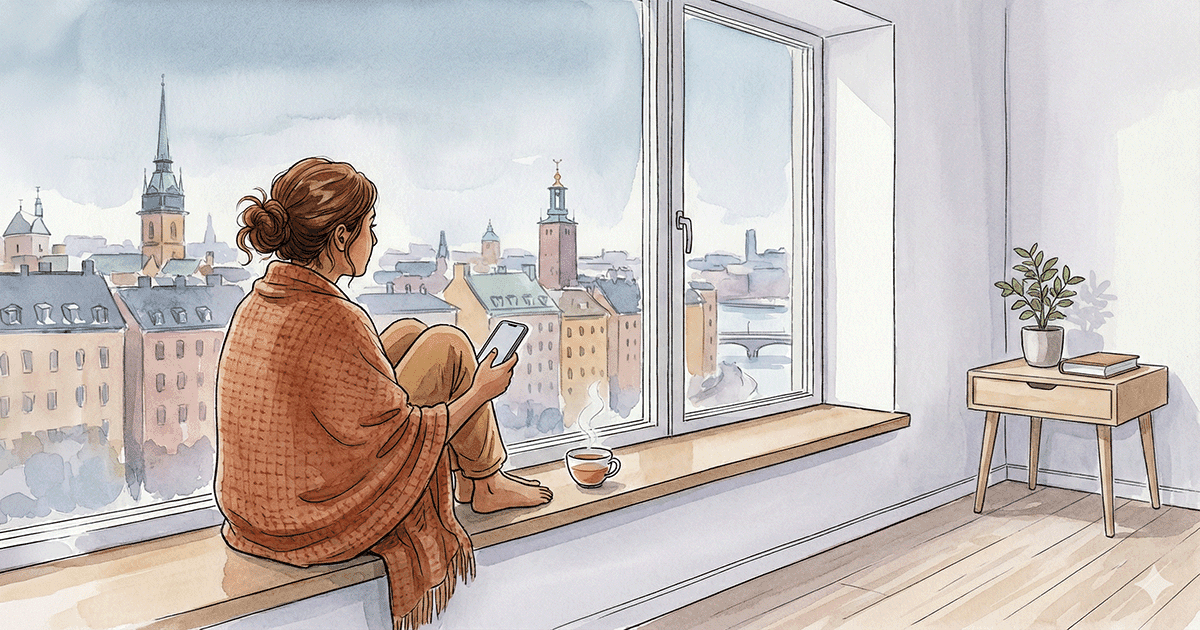
It is Saturday afternoon in Stockholm, and she scrolls through photos of her friends back home. They are at a birthday party, the kind she used to organize. She recognizes the cake, the laughter, the inside jokes she no longer understands because she was not there when they happened.
She moved here two years ago. Her partner's job. A good opportunity. She left behind her career, her family, and a network of friends she had built over decades. She thought she would make new friends. She thought it would feel like home eventually.
Instead, she feels invisible. At the playground, Swedish mothers chat in clusters while she stands alone. At work, colleagues are polite but distant. She has learned the language, adapted to the culture, done everything "right," and still she is lonely in a way that does not make sense to people who have never lived it.
If this feels familiar, you are not imagining it. And the research shows you are far from alone.
The Statistics Nobody Talks About
Loneliness among expatriates is not just common. It is the norm. A 2022-2023 study published in ScienceDirect found that 77.3% of expatriates experienced loneliness, compared to just 46.9% of people who stayed in their home countries. The majority of those expatriates (73.85%) were women.
For refugee and migrant women, the numbers are similarly stark. A systematic review in ScienceDirect documented loneliness rates between 15.9% and 47.7% among resettled refugees, with social isolation rates as high as 61.2%. Risk factors included family separation, being female, being a parent, and acculturative stress.
The mental health consequences are measurable. Among Latina immigrant women studied by PMC, 29% reported moderate to severe depression and 32% reported moderate to severe anxiety. For refugee and asylum-seeking mothers, postpartum depression rates reach 22.5%, significantly higher than the general population.
And the stressors most strongly associated with depression? General perceived stress, immigration-related stress, and, perhaps most telling, social isolation.
As one study on migrant mothers puts it: "During relocation transitions, people disconnect from circles of support and must adapt to unfamiliar environments, with loneliness generating fear, a sense of alienation, and even depression."
What You Lost When You Left
When people ask what is hardest about moving abroad, many expat women struggle to articulate it. It is not one thing. It is the accumulation of invisible losses.
The Support Network You Built Over a Lifetime
In your home country, you likely had what researchers call an extended support network: family members who could help with childcare, friends who understood your history, a community where you belonged without having to explain yourself.
Research on family separation among refugees found that conceptions of family vary dramatically across cultures. In many non-Western cultures, "family" means extended family across three or four generations. In Iraqi culture, researchers note, the word "family" inherently means extended family, making relocation to countries with nuclear family norms profoundly isolating.
The consequences of losing that network are not abstract. A study on relocation and mental health documented extensive grief, adjustment disorders, depression, disrupted family life, and disrupted support networks as direct results of relocation.
When you are alone with a sick child at 2 AM in a country where you do not have a mother or sister to call, that research becomes visceral.
The Identity and Career You Left Behind
If you moved abroad to follow a partner's career, you are in the statistical majority. According to InterNations' 2015 survey, 84% of trailing spouses are women, and 72% of non-working spouses said they left a career when moving abroad.
The term for what often follows is "trailing spouse syndrome," a pattern of isolation, depression, and identity loss that is common enough to have its own name. A 2016 report cited by Al Jazeera found that depression was the biggest affliction among expat women aged 30-49.
Research on trailing spouses identifies loss of identity as the most significant struggle: "Loss of identity is the biggest difficulty for expat spouses, which can set in when a person leaves their home and leaves career, family, social and religious groups, community activities and hobbies."
The toll on relationships is measurable. The divorce rate for trailing spouses is 50%, driven by the stress of adaptation, isolation, and the loss of individual identity.
The Invisible Labour That Multiplies
For expat women who are also mothers, the load becomes unsustainable. A 2022 survey found that 93% of mothers report feeling burned out, with women reporting burnout 32% more often than men. Studies show that mothers perform 73% of all cognitive household labour (the invisible work of planning, organizing, and managing family life), which is directly associated with depression, stress, and burnout.
When you add language barriers, cultural adaptation, and the absence of extended family support, the cognitive load becomes crushing.
Why Making Friends Feels Impossible
One of the most painful aspects of expat loneliness is the confusion. You are likable. You are social. So why does making friends feel so impossibly hard?
The Sweden-Specific Challenge
If you are living in Sweden, the data validates what you are experiencing. Based on interviews with over 21,000 expats in 39 countries, Sweden ranks dead last for making friends.
Part of this is cultural. Swedish social norms emphasize personal distance, privacy, and respect for personal space. There is also Jantelagen (the Law of Jante), an unwritten social code that promotes conformity and discourages standing out, making it difficult for newcomers to break into established social circles.
A 2024 report from Nordic Welfare found that 41% of people who immigrated to Sweden between 1980 and 2024 do not identify as part of Swedish society. Among those with networks of ethnic Swedes, integration rises to 80%. Social connection is not optional for integration. It is the foundation.
The Universal Barriers
Even outside of Sweden, expat women face systematic barriers to friendship formation.
Language is one. Research on immigrant communities shows that language barriers prevent meaningful relationship development. When friendships cross nationality, communication requires more time, more effort, and fluency that many expat women are still building.
Cultural norms around friendship differ. A study in Sage Journals found that immigrant adolescents are significantly more likely to befriend other immigrants than host-country nationals, partly because of shared experience, and partly because of exclusion. Friendship instability was associated with higher depressive symptoms, particularly among those with low levels of acculturation.
Time is another factor. Working expat mothers are already stretched thin. Research in PMC documents how mothers balancing telework and family life experienced anxiety, stress, sleep deprivation, and relationship problems. The isolation that was always there became undeniable.
What Actually Helps
Research shows clear, evidence-based pathways out of loneliness.
1. Cognitive Behavioral Therapy (CBT) for Loneliness
Loneliness is not just about being alone. It is often sustained by thought patterns: Nobody here wants to be my friend. I will never belong. Something is wrong with me.
Research published in Nature found that internet-based CBT (ICBT) interventions for loneliness showed statistically significant reductions in loneliness scores. The intervention combined cognitive restructuring, mindfulness, self-compassion, and social skills training.
CBT helps you identify and challenge the beliefs keeping you stuck. When you think, "I've been here two years and still have no real friends. I must be doing something wrong," CBT asks: Is that thought helping you? Is it true? What would you tell a friend who said that?
2. Mindfulness Training
A 2-week smartphone-based mindfulness study demonstrated remarkable results: mindfulness training that combined monitoring and acceptance reduced loneliness by 22% and increased social contact by two interactions per day compared to control groups.
Mindfulness does not eliminate loneliness. But it helps you relate to it differently, as a feeling you are experiencing, not a truth about your worth.
3. Peer Support and Community Groups
A systematic review of psychological group interventions for refugees found that in-language, culturally adapted group interventions are effective and accessible. Groups are not a replacement for individual therapy, but they provide complementary value, particularly as an early-access intervention.
Research on immigrant women's interventions found significant improvements in mood, depression levels, stress reduction, loneliness reduction, self-esteem, and empowerment. The most effective approaches combined psychoeducation with the creation of social networks in culturally acceptable ways.
For expat women specifically, finding or creating a community of other expat women, even online, breaks the isolation. Studies on peer support show that peer work is safe, effective, and cost-effective, promoting hope, empowerment, and reducing feelings of isolation.
4. Learn the Local Language
Language is one of the biggest barriers to connection. It is also one of the most powerful tools for overcoming it. Learning the local language is the single most practical step toward integration, and the benefits extend far beyond conversation.
Research in the Journal of Population Economics found that language training increases employment probability by over 9 percentage points within two years, opening doors to careers and financial independence that many trailing spouses lost in the move. If you are a parent, the impact reaches your children too. According to the Migration Policy Institute, 78% of parents who speak the local language participate in their children's school events, compared to just 50% in households where neither parent does. You can help with homework. You can talk to teachers. You can advocate for your child in a system you understand.
And here is something worth knowing: research published in Nature shows that learning a second language triggers measurable changes in your brain's gray and white matter, a process called experience-dependent neuroplasticity. Every grammar lesson, every awkward conversation at the grocery store, is building new neural pathways. Your brain is proving that you can grow here.
5. Maintain Home Culture While Integrating Locally
One of the biggest mistakes expat women make is thinking they have to choose: either hold onto their home culture or fully assimilate into the new one.
Research on biculturalism shows the opposite. "Biculturalism appears to involve a sense of comfort with one's multiple backgrounds and a belief that these backgrounds can be integrated, which may then give rise to an experience of flourishing within both cultures simultaneously."
Studies link bicultural identity integration (maintaining affiliation with your home culture while developing belonging in your host country) with better mental health outcomes and better adjustment. A daily diary study in PMC found that maintaining bicultural experiences across days facilitates wellbeing and protects against symptoms of anxiety and depression.
You do not have to choose. Celebrating Diwali and Midsummer is not a contradiction. It is integration.
6. Move Your Body
When your mind is spiraling, replaying that awkward conversation at the playground, imagining that everyone else has friends except you, your body can interrupt the loop. Exercise does not just improve mood. It breaks the thought patterns that keep loneliness alive.
A 2025 study published in ScienceDirect found that just 30 minutes of moderate-intensity exercise reduced self-reported rumination more strongly than sedentary control conditions, and EEG brain scans confirmed it, showing that exercise shifted brain activity away from ruminative loops and toward distraction. The most comprehensive evidence comes from a Cochrane systematic review analysing 73 randomized controlled trials with nearly 5,000 adults: exercise showed similar effects to both psychotherapy and antidepressant medication for treating depression.
For immigrant women specifically, a systematic review of 27 studies with over 4,000 participants found that physical activity interventions improved PTSD, depression, anxiety, and self-efficacy in refugee and migrant populations. You do not need a gym membership. A daily walk, a dance class, a YouTube workout in your living room. What matters is that you move.
7. Acknowledge the Grief
Relocation is not just a logistical challenge. It is a loss. You lost your support network. You lost daily proximity to people who know your history. You may have lost your career, your language, your sense of competence.
Research on relocation documents extensive grief as a normal response to forced or chosen relocation. Naming it as grief, not failure, not weakness, allows you to process it.
Grief does not mean you regret the move. It means you loved what you left behind. Both can be true.
You Are Not Broken. You Are Adapting.
If you have been blaming yourself for not adjusting faster, for not making friends more easily, for feeling lonely in a room full of people, I want you to stop.
The research is unambiguous: 77.3% of expat women experience loneliness. It is not because you are doing something wrong. It is because you are navigating something genuinely difficult. The loss of everything familiar, the work of building a new life from scratch, often while supporting a partner's career and raising children in a culture that is not your own.
You are not failing. You are adapting. And adaptation takes time, support, and self-compassion.
If the loneliness is affecting your mental health, reaching out for support is not a luxury. It is necessary. You deserve to feel at home, and you do not have to do it alone.
✦ Written with AI Assistance
The research and initial draft for this article were developed using Claude by Anthropic. Dr. Swapna Vithalkar reviewed and shaped the final content.