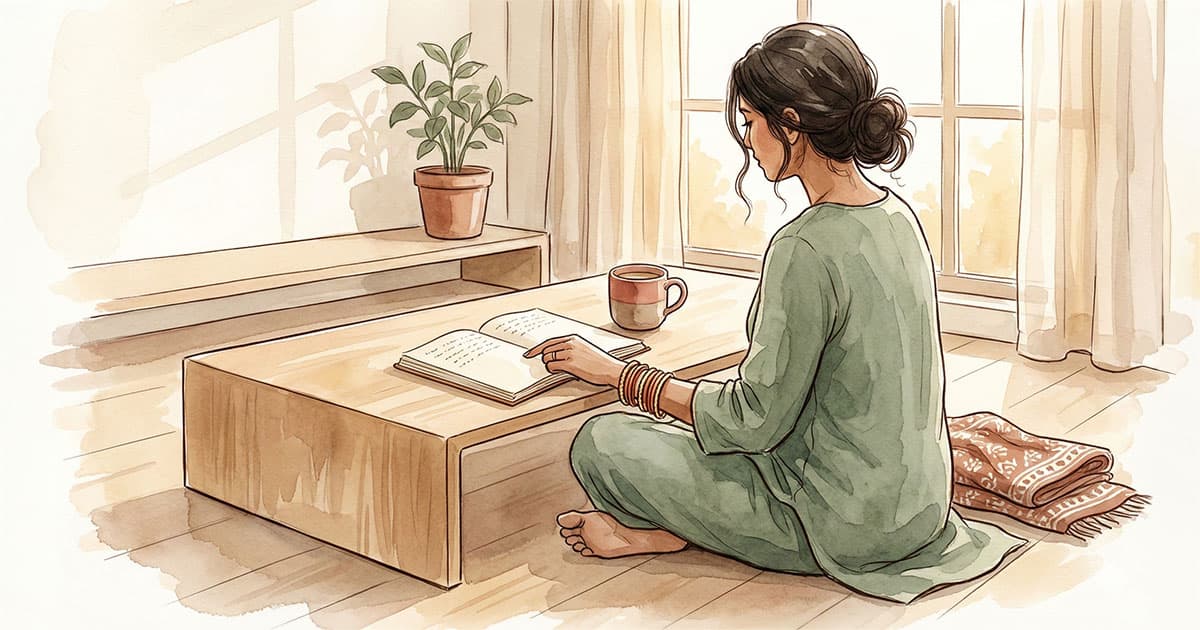
She picks up on the second ring. Her mother is calling from Delhi, and the conversation follows the same familiar script. "Beta, your aunt is asking why you didn't come for Diwali. She's hurt. You know how she is." And just like that, the guilt arrives, heavy, practiced, almost automatic.
She hangs up and spends the next hour composing the perfect apologetic message to an aunt she barely speaks to. Not because she wants to, but because somewhere deep inside, a voice tells her that a good daughter would.
If this feels familiar, you are not alone. And more importantly, you are not broken.
As a psychologist who has worked with women across cultures for over two decades, I have seen this pattern repeated in session after session. South Asian women carry an invisible manual of rules: be selfless, be accommodating, be the peacemaker. They follow it so faithfully that they forget they never wrote it.
This article is about understanding where that manual came from, what it costs you, and how to start writing your own.
The Cultural Blueprint: How "Good Girls" Are Made
In most South Asian families, girls are raised with a specific instruction set. Be respectful. Be modest. Put the family first. Don't be too loud. Don't cause trouble. Adjust.
Research confirms what many women already feel in their bones. A study published in the Journal of Adolescent Research found that South Asian immigrant families maintain stricter socialization rules for daughters than sons, with girls held responsible for preserving traditional values, religious practices, and family honour. Girls learn early that the cost of protest is social exclusion, and the reward for compliance is acceptance.
This runs deeper than a cultural preference. A 2024 study in Sage Journals documented that South Asian families continue to raise girls to be "respectful, modest, self-sacrificing, and obedient," with their worth explicitly tied to how well they serve others.
The instruction reaches its peak at marriage. The phrase "adjust karo" (just adjust) is often delivered on or before the wedding day itself. It means: change yourself to fit your new family. Do not expect them to change for you. A study published in the Indian Journal of Psychiatry found that married women in India report greater psychological distress than married men, driven partly by this one-directional expectation of adaptation.
The phrase that holds the entire system together: "Log kya kahenge?" What will people say? The British Psychological Society described these four words as carrying "the weight of generations," forcing people to perform acceptable versions of themselves that suppress authentic self-expression. The burden falls harder on women, with one participant telling researchers: "We're different; we're treated differently by our own because we're women, we're treated differently outside because we're Asian."
The Price You Pay: When Pleasing Becomes Suffering
People-pleasing has measurable consequences. Not a personality quirk, not a cultural quirk, a pattern with a clinical footprint.
A 2024 YouGov survey of over 1,100 Americans found that 52% of women identify as people-pleasers, compared to 44% of men. Among women, 46% feel responsible for other people's feelings, and 43% struggle to set boundaries. 38% of women said they were socialized to be this way, up from 23% just two years earlier, which tells you something about growing awareness of how deeply this pattern is taught.
For South Asian women, the numbers are starker. Research published in PMC shows South Asian American women have 2.71 times higher odds of developing an anxiety disorder compared to South Asian American men. A study in PMC found that older Indian women living in the UK experience depression and anxiety at 2.8 times the rate of comparable White women, and for Pakistani women, it is 3.15 times.
Aaron Beck, the founder of Cognitive Behavioral Therapy, gave people-pleasing a clinical name: sociotropy: the excessive need for social approval and connection. His research identified it as one of two primary pathways to clinical depression. A meta-analysis spanning 108 independent studies with over 30,000 participants confirmed that women score higher than men on sociotropy, which partly explains why women develop depression at twice the rate of men.
The body registers it too. Harvard-trained psychologist Dr. Natalie Christine Dattilo warns that people-pleasers face heightened burnout risk because the chronic inability to say no floods the nervous system with cortisol and adrenaline. A 2024 systematic review in Frontiers in Endocrinology confirmed elevated cortisol levels among burned-out individuals and found that cortisol predicted future burnout at three months.
And yet many South Asian women do not seek help. According to KFF, only 25% of Asian adults with any mental illness receive mental health services, compared to 52% of White adults in the United States. When your culture frames vulnerability as weakness and mental distress as a lack of faith, reaching out feels like another failure.
The Belief Behind the Behaviour: An REBT Lens
In my practice, I often use Rational Emotive Behaviour Therapy (REBT), a framework developed by Albert Ellis that targets the irrational beliefs driving emotional distress. When it comes to people-pleasing, one belief sits at the centre of everything:
"I must be approved of by virtually every significant person in my life, or else I am not good enough."
Ellis identified this as the most common irrational belief in human psychology. He argued that it is logically impossible (someone will always disapprove), self-defeating (constant compliance erodes respect rather than earning it), and fundamentally a confusion between wanting approval and needing it.
For South Asian women, this belief is not just personal. It is culturally reinforced at every level. The family says: a good daughter adjusts. The community says: a good woman does not cause trouble. The internal voice, shaped by decades of conditioning, says: if I set a boundary, I am selfish.
REBT calls this the "must." Not "I would prefer people to approve of me" (which is healthy), but "I must have their approval, and if I don't, something is terribly wrong with me." The shift from that demand to a preference ("I would like their approval, but I can survive without it") is where the suffering begins to loosen.
The therapeutic work starts with one question: Does setting a boundary actually make you a bad person? When I ask my clients this directly, most of them pause. They know the answer is no. But knowing it and feeling it are two different things, and that gap is where the real work happens.
From "Good Girl" to Grounded Woman: Practical Steps
Breaking the people-pleasing cycle does not mean becoming cold, unfeeling, or abandoning your culture. It means learning to distinguish between generosity that comes from choice and compliance that comes from fear.
Here are five starting points:
1. Name the belief, then question it. When you feel the pull to say yes against your will, pause. Ask yourself: what belief is driving this?
- Irrational belief 1: I will be hurting someone if I say No
- Irrational belief 2: People who say yes are the caring people
- Irrational belief 3: I must say yes to the significant people around me
- Irrational belief 4: I am a selfish person if I prioritise myself over my loved ones
- Irrational belief 5: By saying No, we lose an opportunity to stretch ourselves mentally
- Irrational belief 6: Saying No is a sign of a bad person, so a good person must always say yes to people
Then apply the REBT test: Is this belief true? Is it helpful? What would I tell a friend who believed this?
2. Start with low-stakes boundaries. You do not need to confront your mother-in-law on day one. Start small. Decline a social obligation that drains you. Let a phone call go to voicemail. Notice that the world does not end.
3. Separate guilt from harm. Guilt is a feeling, not evidence. Feeling guilty about saying no does not mean you have actually hurt someone. South Asian women are trained to treat guilt as a moral compass, but guilt triggered by healthy boundaries is a signal of old conditioning, not wrongdoing.
4. Redefine selflessness. True selflessness requires a self to give from. When you are depleted, resentful, and running on empty, what you offer others is not generosity, it is performance. Taking care of yourself is not the opposite of caring for others. It is a prerequisite. Selfishness is good when you are emotionally vulnerable. Prioritising others rather than yourself sometimes is good, but doing it all the time is a sign of a people-pleasing attitude.
5. Find your language: Be assertive without using hurtful words. Many South Asian women find that direct refusal feels too sharp for their cultural context. That is fine. You can set a boundary gently: "I care about this, and I need some time to think about it." "I am not able to do this right now, but I hope you understand." The words matter less than the intention behind them: I am allowed to have needs too.
You Are Allowed to Take Up Space
The transition from "good girl" to grounded woman is a reclamation, not a rejection of your culture. You can honour your family, respect your community, and still hold space for your own needs. These are not contradictions. They are what a healthy, whole life looks like.
If anything in this article resonated with you, I want you to know that seeking support is not a sign of weakness. It takes courage. And you deserve the same compassion you have been giving to everyone else.
✦ Written with AI Assistance
The research and initial draft for this article were developed using Claude by Anthropic. Dr. Swapna Vithalkar reviewed and shaped the final content.